Fundamentals of Transformers and Applications
Introduction to Transformers
Two coils that have mutual inductance make up a transformer. The coil connected to the source of energy is called primary coil and the other is called secondary coil. It is useful in that the electrical energy can be transferred from one circuit to another without direct connection.
It can also change the voltage level from one level to another level depending on the windings ratio of the primary and secondary coils. It can only be used with AC voltage because no voltage is induced if there is no change in magnetic field.
The increase of the inductance of coils can be done by windings the coils on magnetic material like iron core.
Turns Ratio, Voltage and Current
In a varying magnetic field, the voltage induced in a coil is proportional to the number of turns in the coil. If the coils are wound in the same field, the induced voltages will be proportional to the number of turns in each coil.
Vs = Vp(Ns/Np)
where Vs = secondary voltage
Vp = primary voltage
Ns = number of turns on secondary
Np = number of turns on primary
If no current is taken from the secondary(open circuit), the current that flows in the primary is called magnetizing current of the transformer. Typically, the trans. is designed in such a way that the power consumed by it is only to overcome the losses in the iron core and in the resistance of the wire with which the primary is wound.
If the secondary is connected to the load, the current on the primary is given in the formula below assuming that the entire primary current is caused by the secondary load.
Ip = Is(Ns/Np)
where Ip = primary current
Is = secondary current
Ns = number of turns on secondary
Np = number of turns on primary
Impedance Matching
Many devices need a specific value of of load resistance for optimum operation. The impedance of an actual load that is to dissipate the power may differ from this value, so a transformer is used to change the actual load into an impedance of the desired value. This is called impedance matching.
Np/Ns = Square root(Zp/Zs) where
Np = number of turns on primary
Ns = number of turns on secondary
Zp = primary impedance required
Zs = impedance load connected to the secondary
Example : A transistor for audio amplifier requires a load of 200 ohms for optimum operation and is to be connected to a loudspeaker with an impedance of 4 ohms. The turn ratio, Np/Ns required will be Square root (200/4) = 7.1 i.e. the primary must have 7.1 times as many turns as the secondary.
Construction
Two common types of construction are SHELL type and CORE type. In the SHELL type both windings are placed on the inner leg, while in the CORE type the primary and secondary windings may be placed on separate legs. They are usually designed so that the magnetic path around the core is as short as possible.
The material used for the core is usually silicon steel, built up by laminations, insulated from each other by a layer of coating. The number of turns required is inversely proportional to the cross sectional area of the core.
Typically, the windings of small power transformers usually have 6-8 turns/volt on a core of 1 square inch cross section and have a magnetic path of 10-12 inches in length. A longer path or smaller cross section requires more turns/volt and vice versa.
Back To Transformers Home Page

Recent Articles


-
Electronics Design Contest
 Join electronics design contest and win prizes. Test your hardware and software skills against the best designers from the rest of the world.
 -
Garden Watering Circuit
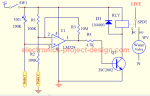 Experiment and test out this automatic garden watering circuit that will detect the moisture of the soil and on or off the water valve accordingly.
 -
Electronics Events
 Join the electronics events to enhance your knowledge and network with other professionals in this industry.
Design and build a battery tester to test dry cell and rechargeable battery with a voltage of less than 2V. Check here.
PCB Prototypes
Make your own printed circuit board and learn the processes involved along the way. More here.
Learn how to dissipate heat from your heat-sensitive electronic components.
Test the reliability of your products to the environment by stressing them in test lab.
Explore the use of 7-Segment Display, 555 Timer, Decade Counter and Binary Adder. Get the circuit.
Construct this simple door bell chime and have fun. Find out more here.
Build this simple home alarm to protect your house from intruders. See the schematic circuit.
New! Comments
Have your say about what you just read! Leave us a comment in the box below.