Constructional Amplifier Projects
Introduction to Amplifier
Amplification is the process of increasing the amplitude of a AC signal current or voltage such as audio signal for sound or video signal for a television picture. The amplifier allows a small input signal to control a larger amount of power in the output circuit. The output signal is a copy of the original input signal but has higher amplitude.
Amplification is necessary as in most applications, the signal is too weak to be used directly. For example, an audio output of 1mV from a microphone is not able to drive a loud speaker which requires a few volts to operate. Hence, the signal need to be amplified to a few volts before it can be fed into the loud speaker.
NPN Transistor Circuit Configuration
An example of different type of transistor configurations in the circuit is as shown in Figure 1 below.
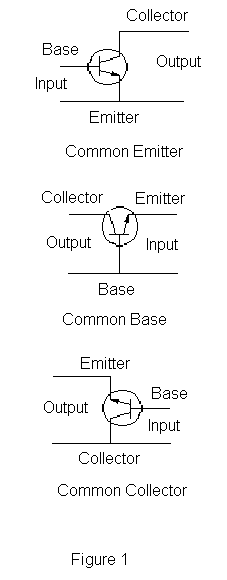
- The common emitter(CE) circuit uses emitter as its common electrode. The input signal is applied to the base and the amplified output is taken from the collector. This is the one generally use because it has the best combination of current gain and voltage gain.
- The common base (CB) circuit uses base as its common electrode. The input signal is applied to the emitter and the amplified output is taken from the collector. The relatively high emitter current compared to the base current results in very low input impedance value. For this reason, the CB circuit is seldom used.
- The common collector (CC) circuit uses collector as its common electrode. The input signal is applied to the base and the amplified output is taken from the emitter. This circuit is also called an emitter follower. This name means that the output signal voltage at the emitter follows the input signal at the base with the same phase but less amplitude. The voltage gain is less than 1 and is usually used for impedance matching. It has high input at the base as a load for the preceding circuit and low output impedance at the emitter as a signal source for the next circuit.
Classes
They can be classified into classes A, B, C and AB. They are defined based on the percent of the cycle of input signal that is able to produce output current.
In Class A, the output current flows for the full cycle of 360 degree of input signal. The distortion is the lowest with around 5% to 10% and an efficiency of 20% to 40%. In general, most small signal operate class A
In Class C, the output current flows for less than one half of the input cycle. Typical operation is 120 degree of input current during the positive half cycle of the input current. This class has an efficiency of 80% but has the highest distortion. This class is usually used for RF amplification with a tuned circuit in the output.
In Class B, the output current flows for one half of the input cycle which is around 180 degree. Class B operation lies between class A and class C. Class B are usually connected in pairs and in such a circuit called push-pull amplifier. The push-pull is often used for audio power output to a loud speaker.
In Class AB, it offers a compromise between the low distortion of class A and the higher power of class B. It is usually used for push-pull audio power amplifiers.
25W Audio Power Amplifier Project
This is a 25 watt audio amplifier module project using LM1875 IC module from National Semiconductor.

Recent Articles


-
Electronics Events
Join the electronics events to enhance your knowledge and network with other professionals in this industry. -
Electronics Design Contest
 Join electronics design contest and win prizes. Test your hardware and software skills against the best designers from the rest of the world.
 -
Garden Watering Circuit
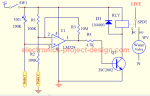 Experiment and test out this automatic garden watering circuit that will detect the moisture of the soil and on or off the water valve accordingly.
Design and build a battery tester to test dry cell and rechargeable battery with a voltage of less than 2V. Check here.
PCB Prototypes
Make your own printed circuit board and learn the processes involved along the way. More here.
Learn how to dissipate heat from your heat-sensitive electronic components.
Test the reliability of your products to the environment by stressing them in test lab.
Explore the use of 7-Segment Display, 555 Timer, Decade Counter and Binary Adder. Get the circuit.
Construct this simple door bell chime and have fun. Find out more here.
Build this simple home alarm to protect your house from intruders. See the schematic circuit.
New! Comments
Have your say about what you just read! Leave us a comment in the box below.