Thermistors' Fundamentals and Applications
Thermistors are a generic name given to thermally sensitive resistors. The word comes from a combination of "thermal resistor". NTC(negative temperature coefficient) type has characteristics in that as its temperature goes up, its resistance comes down.
PTC(positve temperature coefficient) type has characteristics in that as its temperature goes up, its resistance goes up too.
It is a semiconducting ceramic resistor produced by sintering the materials at high temperature and uses metal oxide as its main component. The most commonly used oxides are those of manganese, nickel, cobalt, iron, copper and titanium.
Resistance-Temperature Curves
The thermistor resistance values are normally classified at a standard temperature of 25 °C. B constant is the value calculated from the resistance values at 25 °C and 85 °C.
Most NTC type manufacturers provide tables of either resistance or resistance-ratio versus temperature for each of the material systems that they offer in their respective product lines. Often the manufacturer will also provide the coefficients for the various parts equations in order to assist the designer or user to interpolate the R-T data.
The resistance of a temperature is a function of its absolute temperature. As electrical power being dissipated within a temperature may heat up above its ambient temperature, thus reducing its resistance, it is necessary to test for resistance with temperature. The resistance measured in this way is called RT, which means the resistance is at zero power.
The mathematical expression of it is as below:
Ra=Rbexp[B(1/T1-1/T2)]
of which
Ra is the resistance at absolute temperature T1
Rb is the resistance at absolute temperature T2
B is the constant which depends on the material used
DEFINITION
Temperature coefficient
The temperature coefficient of a thermistor(%/°C) = [-B/(T*T)]*100
Dissipation factor
Dissipation factor is the power in mW required to raise itstemperature by 1° C.
Dissipation factor(mW/°C) = P/dT where
P is Power
dT is raised temperature
Current-time characteristic
The current-time characteristic is the relationship at a specified ambient temperature between the current through it and time, upon application or interruption of voltage to it.
Maximum operating temperature
The maximum operating temperature is the maximum body temperature at which the thermistor will operate for an extended period of time with acceptable stability of its characteristics. This temperature is the result of internal or external heating, or both, and should not exceed the maximum value specified.
Maximum power rating
The maximum power rating is the maximum power whicha thermistor will dissipate for an extended period of time with acceptable stability of its characteristics.
Thermal time constant
Thermal time constant is the time required by the thermistor to change 63% of the difference between its initial and final temperature.
Applications
There are various applications of thermistors. Some of them are listed as below:
- Industrial process controls
- Hot glue dispensing equipment
- Fire protection and safety equipment
- Auto & truck tire curing
- Engine temperatures
- Temperature controlled Soldering irons
- Meteorology
- Burglar alarm detectors
- Oven temperature control
- Refrigeration and air conditioning
- Fire detection
- Medical Applications Food Handling Application

Recent Articles


-
Electronics Events
Join the electronics events to enhance your knowledge and network with other professionals in this industry. -
Electronics Design Contest
 Join electronics design contest and win prizes. Test your hardware and software skills against the best designers from the rest of the world.
 -
Garden Watering Circuit
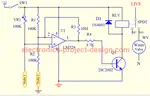 Experiment and test out this automatic garden watering circuit that will detect the moisture of the soil and on or off the water valve accordingly.
Design and build a battery tester to test dry cell and rechargeable battery with a voltage of less than 2V. Check here.
PCB Prototypes
Make your own printed circuit board and learn the processes involved along the way. More here.
Learn how to dissipate heat from your heat-sensitive electronic components.
Test the reliability of your products to the environment by stressing them in test lab.
Explore the use of 7-Segment Display, 555 Timer, Decade Counter and Binary Adder. Get the circuit.
Construct this simple door bell chime and have fun. Find out more here.
Build this simple home alarm to protect your house from intruders. See the schematic circuit.
New! Comments
Have your say about what you just read! Leave us a comment in the box below.