Digital Light Sensor
Do you know what is a light sensor? In applications such as lighting controls, heating ventilation and air conditioning controls or temperature controls system, there are times when you will need to adjust the control parameters based on the intensity of the ambient light. The measurement of the light intensity is thus become one of the important input that cannot be overlooked.
Light intensity is measured using Lux or illumination. An estimate of the light intensity in our everyday life is described as below.
| No | Environment | Illumination |
|---|---|---|
| 1 | Moonlight | <1 lux |
| 2 | Living Room | 45-55 lux |
| 3 | Sunrise | 400-500 lux |
| 4 | Office | 400-500 lux |
| 5 | TV Studio Lighting | 1000 lux | 6 | Bright Sunlight | 32,000-100,000 lux |
The advancement of technology has enabled the accurate measurement of the intensity of light. One such device is the sensor from Intersil ISL29001 that is easily interfaced to any microcontroller unit using I2C. If the microcontroller does not have any I2C pins, normal Input/Output pins can also be used. The extra effort needed is the additional programming code that you will have to do if you use the normal I/O pins.
With this device, you will be able to measure the illumination of the light from 0.3 lux to 10,000 lux. The reading obtained from ISL29001 is in 15 bit digital format with a normal current consumption of less than 300 uA. A power down hardware pin is provided that will enable the MCU to further reduce the current consumption to less than 1uA when not in use. This power saving feature is one of the most critical consideration that you will have to made if your design gets its power from a battery source.
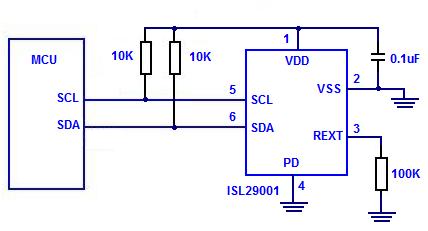
The typical circuit diagram of the I2C interfacing between the digital light sensor and a MCU is as shown above. Notice thata normal open drain I/O pin at the MCU can be used if there is no built-in I2C interface. Other typical features of the device are:
- ROHS compliant. All products exported to Europe have to be ROHS compliant.
- 2.5V to 3.3V DC power supply.
- Adjustable 3-15 counts/lux resolution.
- OPTICAL DUAL FLAT NO-LEAD (ODFN) PLASTIC PACKAGE with a small dimension of 2.1mm X 2.0mm that does not take a lot of space on the printed circuit board.
- 50/60 Hz and IR signals rejection that help to provide accurate readings.
Back To Light Sensor Home Page

Recent Articles


-
Electronics Events
Join the electronics events to enhance your knowledge and network with other professionals in this industry. -
Electronics Design Contest
 Join electronics design contest and win prizes. Test your hardware and software skills against the best designers from the rest of the world.
 -
Garden Watering Circuit
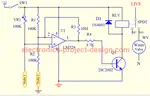 Experiment and test out this automatic garden watering circuit that will detect the moisture of the soil and on or off the water valve accordingly.
Design and build a battery tester to test dry cell and rechargeable battery with a voltage of less than 2V. Check here.
PCB Prototypes
Make your own printed circuit board and learn the processes involved along the way. More here.
Learn how to dissipate heat from your heat-sensitive electronic components.
Test the reliability of your products to the environment by stressing them in test lab.
Explore the use of 7-Segment Display, 555 Timer, Decade Counter and Binary Adder. Get the circuit.
Construct this simple door bell chime and have fun. Find out more here.
Build this simple home alarm to protect your house from intruders. See the schematic circuit.
New! Comments
Have your say about what you just read! Leave us a comment in the box below.