LEDs Fundamentals and Applications
Introduction to LEDs (Light Emitting Diodes)
The primary component in optoelectronics are the LEDs. Light emitting diode is a diode with PN junction of crystal material that produces luminescence around the junction when forward bias current is applied. The junctions of this light emitting diode are made from Gallium Arsenide(GaAs), Gallium Phosphide(GaP)or a combination of both(GaAsP).
The available colors are red, white, yellow, green and blue.Some are housed in plastic affixed to the base header of a transistor package. Others are contained in plastic packages that have a dome shaped head at the light emitting end. Two wires protrude from the opposite end for applying forward bias to the device.
These days, surface mount types are commonly used.
One of the typical example of its application is as shown below.
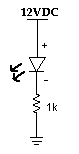
The forward bias current of a typical LED ranges between 10 and 20 mA for maximum brilliance. A 1 kohm resistor in series with a 12 V DC source will caused it to operate at 12 mA. In order to ensure the lifetime of it is preserved, do not exceed the maximum rating of the current. The voltage drop across it is typically 1.8 to 2.0 V DC.
Definition and Terminology
Incident Flux Density
This is defined as the amount of radiation per unit area expressed as lumens/cm2 or watts/cm2. This is the measurement of the amount of flux received by a detector measuring its output.
Emitted Flux Density
This is defined as radiation per unit area and is used to describe light relected from a surface. This measure of reflectance determines the total radiant luminous emittance.
Source Intensity
This is the flux density that will appear at a distant surface and is expressed as lumens/steradian or watts/steradian.
Luminance
This is a measure of photometric brightness and is obtained by dividing the luminous intensity at a given point by projected area of the source at the same point.
A typical specifications of a simple LED is as shown below.
Absolute Maximum Ratings at 25° Celcius
Reverse Voltage = 5V
Forward Current = 20mA to 30mA
Forward Current Peak at 1/10 Duty Cycle, 0.1ms pulse width = 100mA to 150mA
Power Dissipation = 100mW to 150mW
Operating Temperature = -40° Celcius to +85° Celcius
Storage Temperature = -40° Celcius to +85° Celcius
Operating Characteristics
Typical Forward Voltage at 20mA = 1.7V to 2.0V
Maximum Forward voltage at 20mA = 2.5V
Reverse current when 5V reverse voltage is applied = 10 uA
Peak emission wavelength at 20mA = 627nm to 700nm (value depends on the colout of the LED)
Spectral line half width at 20mA = 20nm to 45nm
Capacitance at 0V forward voltage and (f=1MHz) = 35pF to 45pF
Manual Soldering of LEDs
Soldering tool wattage should be less than 30 Watt.
Soldering temperature should be less than 300 °Celcius.
Soldering time should be less than 30 seconds.
Back To LEDs Home Page

Recent Articles


-
Electronics Events
Join the electronics events to enhance your knowledge and network with other professionals in this industry. -
Electronics Design Contest
 Join electronics design contest and win prizes. Test your hardware and software skills against the best designers from the rest of the world.
 -
Garden Watering Circuit
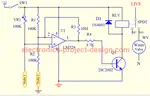 Experiment and test out this automatic garden watering circuit that will detect the moisture of the soil and on or off the water valve accordingly.
Design and build a battery tester to test dry cell and rechargeable battery with a voltage of less than 2V. Check here.
PCB Prototypes
Make your own printed circuit board and learn the processes involved along the way. More here.
Learn how to dissipate heat from your heat-sensitive electronic components.
Test the reliability of your products to the environment by stressing them in test lab.
Explore the use of 7-Segment Display, 555 Timer, Decade Counter and Binary Adder. Get the circuit.
Construct this simple door bell chime and have fun. Find out more here.
Build this simple home alarm to protect your house from intruders. See the schematic circuit.