Home Lighting System Project
In recent year, the control of Home Lighting System has developed from standalone type to more complicated networking controls. Many building management system and even the security system have incorporate the control of lighting into their system as a total solution to their customers. However, there are still no single universal protocol for the building or lighting control system.
The lighting industry has developed a new standard for communication with electronic ballast. Electronic ballast is a common lighting device that is used in practically every building, factory or residential house. This standard called IEC 929 is an interface standard for communication between a controller and the electronic ballast.
The standard for the control is called DALI, an acronym for Digital Addressable Lighting Interface. DALI is meant for home or industry use which has 2 wire communication connection between the master-slave and slave-slave. It is developed to reduce the cost of implementation.
Among the features that can be applied are dimming features and control for different grouping/section of the building.
The electronic ballasts can have up to 16 groups and each group can have up to 16 different lighting parameters for the lighting scenes. Each controller can controlled up to 64 electronic ballasts.
There are many ways to implement the DALI depending on the cost and requirements of a home or building. Most of the time, a microcontroller is used at both the slave and the master controller units as this is one of the most cost effective ways to implement the system.
Freescale Semiconductor has developed a prototype and solution based on DALI using its MC68HC908KX8 device. This is a good reference project for students and beginners to inter-networking of devices. The full application design can be downloaded from its website.
When implementing this project, take into consideration the wires used. Learn and find out more about the effect of cross talk and methods that are used to overcome it. You will enjoy doing this project if this is your first time of doing networking of devices.
Back To Home Lighting System Home Page

Recent Articles


-
Electronics Events
Join the electronics events to enhance your knowledge and network with other professionals in this industry. -
Electronics Design Contest
 Join electronics design contest and win prizes. Test your hardware and software skills against the best designers from the rest of the world.
 -
Garden Watering Circuit
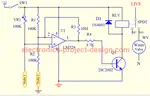 Experiment and test out this automatic garden watering circuit that will detect the moisture of the soil and on or off the water valve accordingly.
Design and build a battery tester to test dry cell and rechargeable battery with a voltage of less than 2V. Check here.
PCB Prototypes
Make your own printed circuit board and learn the processes involved along the way. More here.
Learn how to dissipate heat from your heat-sensitive electronic components.
Test the reliability of your products to the environment by stressing them in test lab.
Explore the use of 7-Segment Display, 555 Timer, Decade Counter and Binary Adder. Get the circuit.
Construct this simple door bell chime and have fun. Find out more here.
Build this simple home alarm to protect your house from intruders. See the schematic circuit.
New! Comments
Have your say about what you just read! Leave us a comment in the box below.