Time Delay Circuit
Looking for a simple time delay circuit? In the design of analog circuits, there are times when you would need to delay a pulse that came into a circuit before being used for the next process. This circuit uses a 555 timer to delay a pulse that comes in to a maximum time of 75 seconds. The timing of the delay can also be changed by changing the resistor value of VR1 and the capacitor value of E based on the time delay formula of t=0.69RC.
In order for the output to go high, the reset pin of 555 timer (pin 4) must be high and the TRIGGER pin (pin 2) voltage level must be below a third of the level of the power supply to the IC. When there is no pulse being applied to the input, transistor Q1 will turn ON and capacitor E is charged.
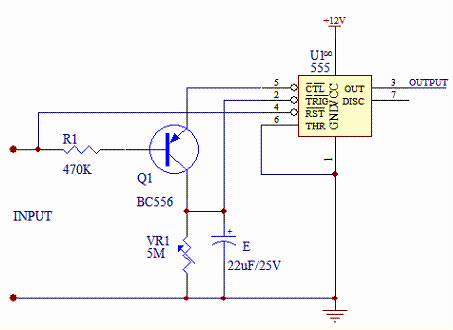
Once a pulse is applied to the input, transistor Q1 will turn OFF and pin 4 reset pin is held to high. This caused the capacitor E1 to be discharged through VR1 resistor. The time delay will depend on the discharged of capacitor E to a third of the supply before the output of 555 goes high. Experiment with different values of VR1 and E to get different time delay.
If the maximum value of potentiometer is set to 5M ohm, the time delay of the pulse will be 75 seconds.
Parts List
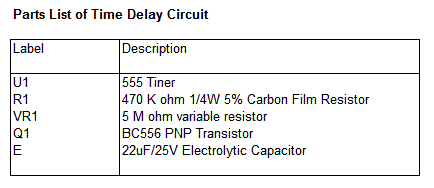
This is a good project to embark on if you are a beginners to electronic design. There are only 5 components needed to construct this circuit. It will provide you a good hands-on experience of using the 555 integrated circuit, one of the most commonly available IC widely in use for the past decades.
Back To Time Delay Circuit Home Page

Recent Articles


-
Electronics Design Contest
 Join electronics design contest and win prizes. Test your hardware and software skills against the best designers from the rest of the world.
 -
Garden Watering Circuit
 Experiment and test out this automatic garden watering circuit that will detect the moisture of the soil and on or off the water valve accordingly.
 -
Electronics Events
 Join the electronics events to enhance your knowledge and network with other professionals in this industry.
Design and build a battery tester to test dry cell and rechargeable battery with a voltage of less than 2V. Check here.
PCB Prototypes
Make your own printed circuit board and learn the processes involved along the way. More here.
Learn how to dissipate heat from your heat-sensitive electronic components.
Test the reliability of your products to the environment by stressing them in test lab.
Explore the use of 7-Segment Display, 555 Timer, Decade Counter and Binary Adder. Get the circuit.
Construct this simple door bell chime and have fun. Find out more here.
Build this simple home alarm to protect your house from intruders. See the schematic circuit.
New! Comments
Have your say about what you just read! Leave us a comment in the box below.