Automotive Keyless Lock
Keyless Lock
Most vehicles today have remote controls with two buttons that control the locking and the unlocking of the doors of the vehicles. The development of RFID (Radio Frequency Identification) technology will soon replace this method of opening and closing of the doors. When a transponder is placed near a reader, it will start to communicate with the reader and once the information exchange is successful, the door will open.
Chances are that you will have seen this technology been implemented on higher end cars these days. It is more convenient and safe as you do not have to scramble for key on your purse or pocket before being able to open the door and after that using the same key to start the engine.
A transponder consists of an antenna with a microchip which is embedded into a plastic tag. It is usually light weight and is designed to take the impact of normal mechanical stress.
When the owner of the vehicle with the transponder in the pocket walks towards the car, the doors of the car will automatically open once the owner is within a few feet from the car. One does not need to search frantically for the remote control of the car in order to open it.
Other features incorporated may include the triggering of lights when the doors opened, auto lock once the owner moves away from the car and other features. Many luxury cars manufacturers have already implemented this keyless lock technology in their vehicles and it is forecast that middle range cars will follow suit soon.
Microchip new PIC16F639 flash MCU which has 3 channel, transponder analog front end and KEELOQ cryptographic peripheral is an ideal microchip to be used in the transponder. The 3 channels has omnidirectional 125kHz low frequency communication that are used to communicate with the base station or the reader. This device can also be used in other wireless authentication applications. An example of the passive keyless entry application circuit is shown below.
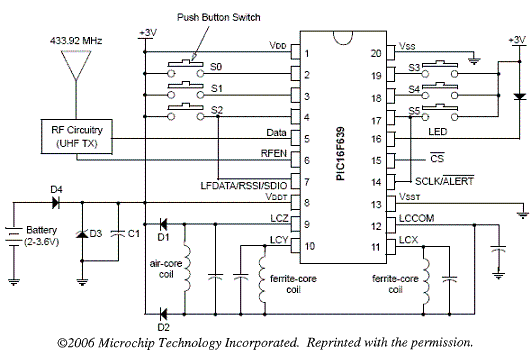
The KEELOQ technology is a non linear encryption algorithm that creates a unique transmission on every use, making the capturing and resending of the same code useless. Hence the security feature is protected from intruders.
This solution from Microchip contains 3 modules. They are the Key Fob, the Base Station and the Receiver/Decoder.
The Base Station starts the communication with the Key Fob by sending out the 125kHz signal. The Key Fob receives and decodes the challenge from the Base Station. If there is a match, the Key Fob will transmit a 432MHz signal back to the Receiver/Decoder. If the Receiver/Decoder recognizes the Key Fob as a valid device, it will send out a signal to unlock the door.
Back To Keyless Lock Home Page

Recent Articles


-
Electronics Design Contest
 Join electronics design contest and win prizes. Test your hardware and software skills against the best designers from the rest of the world.
 -
Garden Watering Circuit
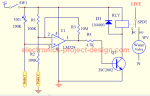 Experiment and test out this automatic garden watering circuit that will detect the moisture of the soil and on or off the water valve accordingly.
 -
Electronics Events
 Join the electronics events to enhance your knowledge and network with other professionals in this industry.
Design and build a battery tester to test dry cell and rechargeable battery with a voltage of less than 2V. Check here.
PCB Prototypes
Make your own printed circuit board and learn the processes involved along the way. More here.
Learn how to dissipate heat from your heat-sensitive electronic components.
Test the reliability of your products to the environment by stressing them in test lab.
Explore the use of 7-Segment Display, 555 Timer, Decade Counter and Binary Adder. Get the circuit.
Construct this simple door bell chime and have fun. Find out more here.
Build this simple home alarm to protect your house from intruders. See the schematic circuit.
New! Comments
Have your say about what you just read! Leave us a comment in the box below.