Vibration Testing For Reliability of Electronic Devices
Vibration testing is the shaking or shocking of a component or assembly to see how it will stand up to real life environment. In electronics, it is used it to test the ability of printed circuit boards and its assembly or electronic components to withstand real life situation when these devices are shipped by means of air, sea or land.
Real life environment also includes simulating its normal or extreme operational conditions where it is operating. Damaged is most likely to occur when the device is vibrated at its natural or resonant frequency.
There are typically 3 vibration levels that can be used as a guide for the reliability engineer. However, he may choose to establish different criteria for any device based on the projected service environment.
The 3 levels are light vibration, medium vibration and heavy vibration. Light vibration is tested for electronic devices that are mounted on the walls. Medium vibration is tested for equipment that have electronic control boxes mounted into them. Heavy vibration is for those installation that are used in moving vehicles e.g. truck, trailers or cars.
There are 3 types of tests that are usually performed. They are shipping, performance and endurance vibration. There are orthogonal axes of the device that will be tested. They are identified as X, Y and Z axis. Tests will be performed on each of the 3 axis. The test methods below are just for references. Always check the specifications and test methods that you would like to use for your particular device.
Shipping Vibration
This test is used to simulate the vibration levels that occurred when devices are transported using rail or truck. This test is usually done with the devices packed at its final packaging for shipment. The electronic devices must be able to withstand 1G of random vibration with frequency sweep from 3 to 50 Hz for 20 minutes in each axis.
After the testing is done, physical checking for internal or external damage will determine whether the product passed the test. Electrical testing also need to be evaluated after the test.
Performance Vibration
Performance vibration testing is done to examine the functional performance of the device during the test. An example of the vibration level is as shown in the table below.
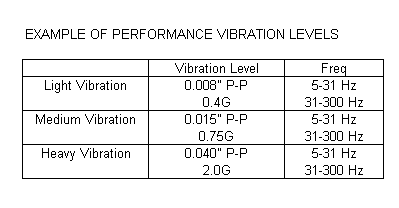
After the testing is done, physical checking for internal or external damage will determine whether the product passed the test. Electrical testing also need to be evaluated after the test.
Endurance Vibration
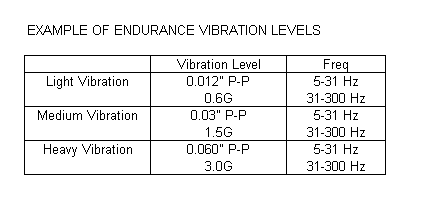
Endurance vibration testing is done to examine the performance of the device when it is vibrated at its resonant frequency. An example of the vibration level is as shown in the table below.
Back To Vibration Testing Home Page

Recent Articles


-
Electronics Design Contest
 Join electronics design contest and win prizes. Test your hardware and software skills against the best designers from the rest of the world.
 -
Garden Watering Circuit
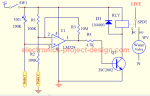 Experiment and test out this automatic garden watering circuit that will detect the moisture of the soil and on or off the water valve accordingly.
 -
Electronics Events
 Join the electronics events to enhance your knowledge and network with other professionals in this industry.
Design and build a battery tester to test dry cell and rechargeable battery with a voltage of less than 2V. Check here.
PCB Prototypes
Make your own printed circuit board and learn the processes involved along the way. More here.
Learn how to dissipate heat from your heat-sensitive electronic components.
Test the reliability of your products to the environment by stressing them in test lab.
Explore the use of 7-Segment Display, 555 Timer, Decade Counter and Binary Adder. Get the circuit.
Construct this simple door bell chime and have fun. Find out more here.
Build this simple home alarm to protect your house from intruders. See the schematic circuit.
New! Comments
Have your say about what you just read! Leave us a comment in the box below.