Spectrum Analyzer
Introduction to Spectrum Analyzer
The main function of this analyzer is to produce a display of the frequency contents of an input signal. The analyzer can be described as a frequency-selective, peak-responding voltmeter calibrated to display the rms value of a sine wave.
The oscilloscope plots the amplitude in the time domain whereas the analyzer plots the amplitude in the frequency domain. The analyzer is a wide band, very sensitive receiver. It works on the principle of "super-heterodyne receiver" to convert higher frequencies up to several 10s of GHz to measurable quantities.
The received frequency spectrum is slowly swept through a range of pre-selected frequencies, converting the selected frequency to a measurable DC level and displaying it.
This analyzer is useful in studying interference and in troubleshooting radio equipment. It is a superheterodyne receiver with special filters, attenuators, amplifiers and display.
It has an input attenuator, followed by the input filter. The RF signal is fed into the mixer along with the swept local oscillator signal. The sweep generator also controls the display so that the horizontal sweep of the display is synchronized to the sweep of the local oscillator.
The bandwidth filter determines the basic resolution of the spectrum analyzer. After the bandwidth filter, the signal is fed to the logarithmic amplifier. This allows a greater range of signal amplitude to be displayed on the screen of the analyzer. The signal is then detected, cleaned up by the video filter and applied to the display circuitry.
Applications
a) Device Frequency Response Measurements
Measuring the amplitude response (typically measured in dbm) against frequency of device. The device may be anything from a broadband amplifier to a narrow band filter.
b) Microware Tower Monitoring
Measuring the transmitted power and received power of a microwave tower.
c) Interference Measurements
It can be used to verify identify and interferences. Any such interfering signals need to be minimized before going ahead with the site work. Interference can be created by a number of different sources, such as telecom microwave towers, TV stations, or airport guidance systems.
d) Other measurements could be in the areas of Return-loss measurement, satellite antenna alignment, Spurious signals measurement, Harmonic measurements and Inter-modulation measurements.
Points to consider before buying the spectrum analyzer
Stability
Instrument stability is important for maintaining a steady signal display on the screen over time. Instability will manifest itself as a constant drift of the display, especially when lower scan-width settings are used.
The scan width refers to the frequency span per division, or the sweep width setting of the instrument. For example, if the scan width is set to 1MHz/div, and 10 horizontal divisions are on the graticule, then the total scan width is 10MHz.
Frequency range
The instrument must be able to cover the desired frequency range. Typically, the spectrum analyzer used in land mobile radio work should cover the frequency range of 100kHz to 1,000MHz.
Input Power Range
This is the range of input power that could be fed to the analyzer input connector. Normally, this ranges from -100 dBm to +10 dBm. Beyond the lower limits, the spectrum analyzer may not be able to identify the signal from back ground noise.
If you feed signals beyond the maximum specified range, it is possible that the input mixer is saturated and the reading shown on the spectrum analyzer may not represent the actual power levels accurately.
There is also a likelihood of damaging the front-end component of the analyzer. Use an external attenuator if it is required to measure power levels beyond the specified limits. Note that analyzers are available for various input signal power levels.
Harmonics
The frequency harmonics is a measure of accuracy of the analyzer. Normally, the harmonics are greater than 30 dB below the desired signal. The harmonics add to the measurement uncertainty, and should be kept to the minimum.
Scan width
The scan width determines how much of the spectrum is displayed on the analyzer screen. At 100MHz/div, the total sweep width is 1,000MHz. Expect to see lots of clutter at that scan width from an off-the-air display-especially with the instrument set for medium to high sensitivity.
Such a setting might be used to search for an interference signal or to look at the harmonic of a transmitter signal while simultaneously trying to view the fundamental. The lowest scan-width setting is important, too. For example, to view the individual sidebands of a FM transmitter, modulated by a 1kHz tone, the scan width should be set to 1kHz/div to separate the individual sidebands by one division.
Some analyzers do not provide such a low scan-width setting because they don't have sufficient resolution required for viewing this type of display.
Resolution bandwidth
This is an important specification for a spectrum analyzer. The resolution bandwidth determines how far apart two or more signals must be to be resolved into separate and distinct displays on the analyzer.
For example, if two signals are 1kHz apart, a spectrum analyzer with a resolution bandwidth of 10kHz could not resolve the signals into separate displays. Generally speaking, the resolution bandwidth should be about 10% of the signal separation for good resolution on the analyzer display. For example, to display two or more signals that are 1kHz apart, the resolution bandwidth should be set to 100Hz, and the scan width should be set to 1kHz/div.
Sensitivity
Spectrum analyzer sensitivity will determine the minimum level of a signal that can produce a usable display. This will, in turn, depend on the noise floor or noise figure of the spectrum analyzer. The minimum detectable signal will not be less than the noise floor of the analyzer.
The noise floor will depend on the resolution bandwidth and the video filter used (the greater the resolution bandwidth, the higher the noise floor). All other things remaining the same, decreasing the resolution bandwidth by a factor of 10 will drop the noise floor by 10dB. For example, if the noise floor is 2110dB at a resolution bandwidth of 10kHz, then the noise floor will drop to 2120dBm at a resolution bandwidth of 1kHz.
A point is reached where further dropping the resolution bandwidth by a factor of 10 does not result in a 10dB improvement in the noise floor.
If a signal input is equal to the noise floor of the analyzer (at a particular resolution bandwidth setting), then a 3dB "bump" will appear on the analyzer display. Because the input signal is equal in level to the noise floor, the two factors combine to be twice as much, or 3dB greater, than the noise floor.
Back To Spectrum Analyzer Home Page

Recent Articles


-
Electronics Design Contest
 Join electronics design contest and win prizes. Test your hardware and software skills against the best designers from the rest of the world.
 -
Garden Watering Circuit
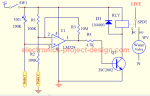 Experiment and test out this automatic garden watering circuit that will detect the moisture of the soil and on or off the water valve accordingly.
 -
Electronics Events
 Join the electronics events to enhance your knowledge and network with other professionals in this industry.
Design and build a battery tester to test dry cell and rechargeable battery with a voltage of less than 2V. Check here.
PCB Prototypes
Make your own printed circuit board and learn the processes involved along the way. More here.
Learn how to dissipate heat from your heat-sensitive electronic components.
Test the reliability of your products to the environment by stressing them in test lab.
Explore the use of 7-Segment Display, 555 Timer, Decade Counter and Binary Adder. Get the circuit.
Construct this simple door bell chime and have fun. Find out more here.
Build this simple home alarm to protect your house from intruders. See the schematic circuit.
New! Comments
Have your say about what you just read! Leave us a comment in the box below.